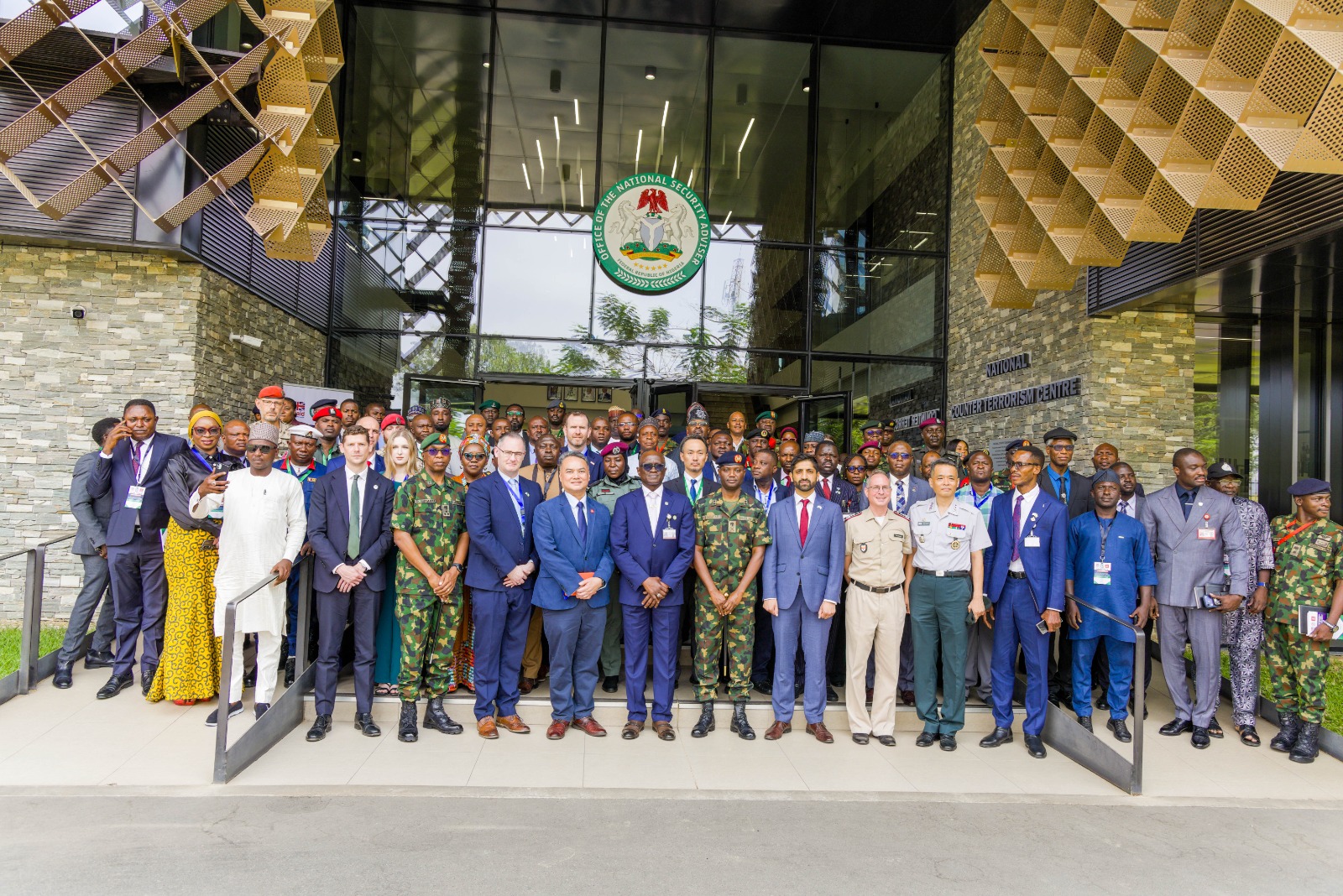
Nigeria has inaugurated a national baseline assessment to boost its counter-terrorism efforts against Improvised Explosive Devices (IEDs).
The initiative, led by the National Counter Terrorism Centre, was unveiled on Wednesday in Abuja during the Counter-Improvised Explosive Devices Baseline Self-Assessment Workshop.
The News Agency of Nigeria (NAN) reports that the workshop was organised in collaboration with the United Nations Mine Action Service and the British High Commission.
Speaking on behalf of the National Security Adviser, Nuhu Ribadu, the National Coordinator of the centre, Maj.-Gen. Adamu Laka, said the exercise was designed to critically examine Nigeria’s existing counter-IED capabilities and identify operational gaps across security institutions.
Laka described the initiative as a strategic follow-up to the Counter-IED Symposium held in March 2025 and a key step toward developing a comprehensive National Counter-IED Strategy.
He said IEDs remained one of the most dangerous weapons used by terrorist groups, particularly in the North-East, posing serious threats to military personnel, civilians and national infrastructure.
He noted that beyond the loss of lives and injuries, IEDs attacks had severely disrupted farming and economic activities, restricted humanitarian operations, displaced communities and weakened investor confidence in affected areas.
“These impacts go far beyond the battlefield and continue to affect the stability and recovery of communities across the country,” he said.
Laka explained that the assessment would utilise the Counter-IED Self-Assessment Framework developed by the United Nations Institute for Disarmament Research to generate empirical data and strengthen coordination among security agencies.
In her remarks, First Secretary at the British High Commission, Annup Vyas, said the United Kingdom was proud to support Nigeria in confronting the persistent threat posed by IEDs.
Vyas noted that the workshop marked an important milestone in the UK-Nigeria security and defence partnership aimed at strengthening national and regional stability.
“The threat from improvised explosive devices is ongoing and deeply damaging to lives, communities and regional stability.
“IEDs do not distinguish between soldiers, civilians or infrastructure. Their impact cuts across everything Nigeria is working to protect,” he added.
He emphasised that effective responses to the threat required not only resources and commitment but also a clear understanding of strengths, gaps and areas requiring improvement within Nigeria’s counter-IED architecture.
According to him, the assessment framework provides a structured methodology to evaluate national capabilities across prevention, detection, mitigation, investigation and consequence management.
Also speaking, the Commander of the Nigerian Army Corps of Engineers, Shamsideen Shafaru, said IEDs remain one of the most adaptive weapons used by hostile groups across several operational theatres.
Shafaru stressed that defeating the threat required a unified, intelligence-driven and capability-focused approach involving military, security, intelligence and civilian stakeholders.
He said the workshop would examine existing procedures, training frameworks, equipment and coordination mechanisms to identify capability gaps and strengthen operational synergy.
Shafaru reaffirmed the commitment of the Nigerian Army Corps of Engineers to supporting national counter-IED efforts through combat engineering expertise, technical innovation and force protection initiatives.
Edwin Faigmane, UNMAS Country Representative, said the workshop was part of a broader initiative to strengthen national capabilities in IED threat mitigation, protect civilians, and ensure the safety of security personnel.
Faigmane said the work of UNMAS focuses on mitigating threats from IEDs to personnel, civilians, and critical infrastructure.
He noted that the workshop uses a C-IED capability maturity self-assessment tool, developed by the United Nations Institute for Disarmament Research, which allows participating security agencies to evaluate and prioritize national C-IED capacities.
Participants at the workshop include representatives of the armed forces, security and intelligence agencies, ministries, departments and agencies, as well as international partners supporting Nigeria’s counter-terrorism efforts.(NAN)
