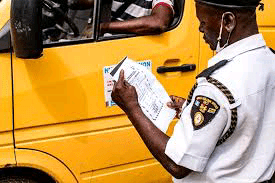
Man Challenges VIO Officers on the road, Cites Federal High Court Ruling

A video circulating widely on Facebook and other social media platforms shows Nigerian citizen confronting Vehicle Inspection Officers (VIO) during a roadside encounter, asserting that the officers have no legal authority to conduct enforcement activities on federal roads. In the footage, the man is heard questioning the officers by asking:
“Oga what do you want? Are you bigger than the Federal High Court? Do you know the two of you can be held in contempt of the court order? ”
a reference to a recent court judgment limiting VIO powers.
In the viral clip, Ekeke argues passionately with uniformed VIO personnel, insisting that their presence on the road and attempts to stop motorists are unlawful. Although details about where and when the video was recorded remain unverified, the recording has sparked intense discussion online about the legal mandate of VIO officers.
His remarks are linked to a landmark legal development that has significantly curtailed the enforcement powers of the Vehicle Inspection Office:
In October 2024, a Federal High Court in Abuja ruled that the Directorate of Road Traffic Services (DRTS), which oversees VIO, is not empowered by any law to stop, impound, confiscate vehicles or impose fines on motorists on Nigerian roads. The judgement arose from a fundamental rights case brought by lawyer Abubakar Marshal, who argued that such actions violated motorists’ constitutional rights to freedom of movement, fair hearing, and property ownership.
Building on that decision, in December 2025, the Court of Appeal in Abuja upheld the High Court’s judgment, dismissing VIO’s appeal as lacking merit and affirming that only a competent court has the authority to impose fines or other sanctions on motorists. The appellate court also issued a perpetual injunction restraining the agency and its agents from continuing enforcement activities deemed unlawful.
These rulings have been widely reported and referenced in public discourse, particularly among motorists who see them as a shield against what many describe as extra-judicial enforcement on Nigerian roads.
The confrontation has triggered a mix of support and criticism online. Supporters argue that the court rulings are clear and that law enforcement must respect judicial authority, while critics contend that enforcement agencies still have a role in ensuring road safety , a debate that touches on the broader issue of traffic regulation and the rule of law in Nigeria.
Legal experts say that although the court order limits VIO operational powers in the Federal Capital Territory (FCT) and similar rulings could affect practices elsewhere, the Federal Road Safety Corps (FRSC) and other statutory traffic agencies remain empowered to enforce traffic laws where authorized by law.
According to the Federal High Court and the Court of Appeal, no statute currently vests VIO officers with the power to stop motorists, seize vehicles, or impose penalties on the road. The rulings underscore the constitutional protections for citizens against unlawful deprivation of property, freedom of movement, and due process.
As the debate continues online, the viral video of Ekeke confronting the officers highlights ongoing public awareness and scrutiny of the enforcement boundaries of road traffic agencies in Nigeria.
