

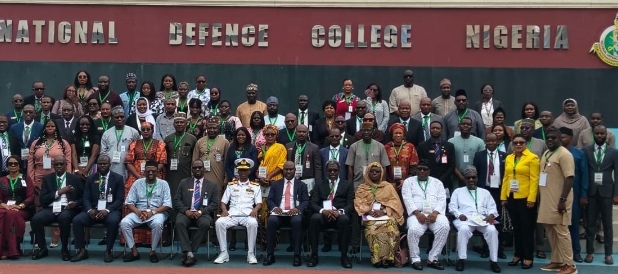
The Commandant of the National Defence College, Rear Adm. Abdullahi Ahmed says the success of tax reforms depends on effective implementation, stakeholder understanding and public confidence.
Ahmed said this at a one day national round-table on recent tax reforms in Nigeria titled ”Policy Clarity, Implementation Challenges and Stakeholders Dialogue”, on Tuesday in Abuja.
According to Ahmed, every government is ultimately measured by its ability to deliver services, and every service is delivered upon revenue.
He said that nations across the world were increasingly recognising that sustainable development must be driven by strong domestic resource mobilisation.
”For Nigeria, this reality has made tax reform not merely a fiscal issue, but a strategic national priority. However, the successes of these reforms will depend not only on policy design.
”It needs effective implementation, stakeholder understanding and public confidence. Nigeria’s ongoing taxes reforms are designed to strengthen fiscal sustainability, improve revenue administration, enhance transparency, and create a more efficient tax system.
”At the National Defence College, we recognise that fiscal governance contributes directly to national stability, economic growth, and sustainable development,” he said.
The NDC commandant also said that a nation that could effectively mobilise and manage its resources would be better positioned to meet the aspirations of its citizens and address emerging national challenges.
He urged the round-table participants, constituting policymakers, revenue authorities, legislators, private sector representatives, civil society organisations, and development partners to engage openly and constructively.
He charged them to exchange perspectives, identify implementation challenges, and explore practical solutions throughout the session.
Speaking on the sidelines, he said that the round-table aimed to aid understanding of the current tax review and to also enlighten the public so they would ultimately appreciate the government’s efforts better.
Meanwhile, the Executive Chairman of the FCT Inland Revenue Service (FCT-IRS), Mr Michael Ango, said that the only sustainable means of societal development was through efficient taxation.
According to Ango, among the most developed countries or societies in the world today, none essentially developed through the use of mineral resources in spite of having mineral wealth as a base.
”They all made good use of taxation and Nigeria is no exception in spite of being a country blessed with several mineral resources.
”The tax reforms were one of the most transparent reforms in Nigeria history where it was open for all to review.”
Speaking on the defence sector receiving improved allocations, he said that it was important as it would ensure that the military was properly funded to keep the country secured.
”Societies can only thrive where there is peace, stability, and security. Taxes can only be collected if the country thrives and we live in a stable society,” he said.
The NDC Provost, Prof. Adam Ahmed in his remark, recounted the history of taxation in Nigeria from the time Nigerians were paying tax to the British as it was deemed civilised among other factors.
”If your society is not civilised, you won’t pay tax. It is only in jungle environment that they don’t pay tax. The British also felt that taxation is also a way by which citizens show loyalty to the government,” he said.
He added that taxation had since been modernised with taxes being tied to good governance, accountability, among others.
”No sane society disagrees on taxation; the debate has always been on the level, rate, expansion, parameter of it. Recently Nigerian government came with a new taxation that put a lot of Nigerians in confusion.
”It is based on that, that the college commandant insisted that the college gets a partner that will be able to explain these things to Nigerians who are not clear on it,” he said.
(NAN)