By Sumaila Ogbaje
The Nigerian Navy has launched a renewed push to strengthen its legal capacity amid rising concerns over failed maritime prosecutions, procedural lapses and growing complexities in enforcing law across Nigeria’s waters.
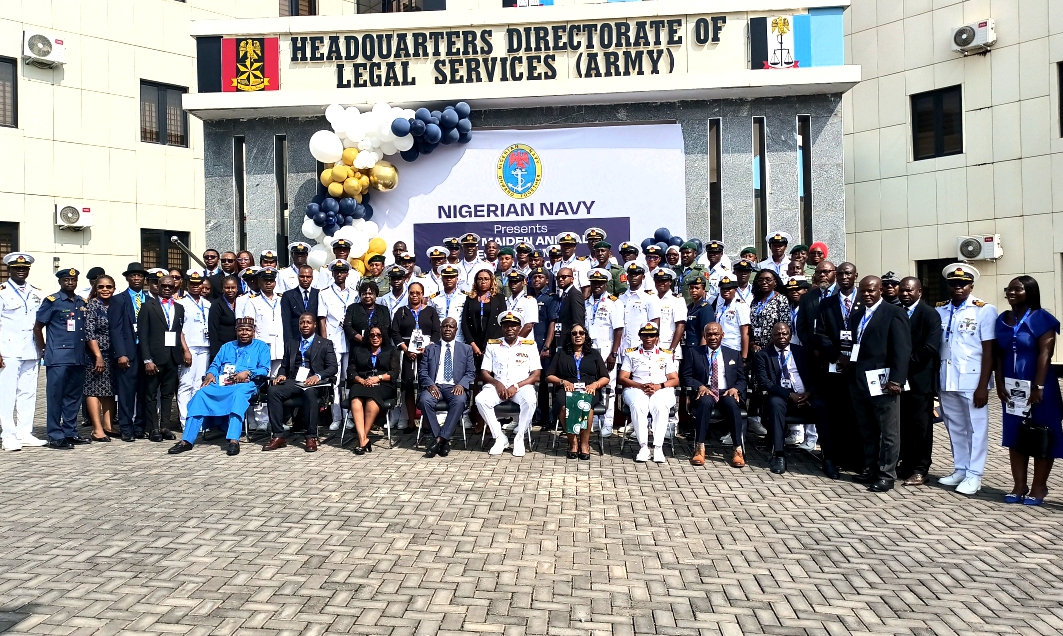
The Chief of Administration (Navy), Rear Adm. Jonathan Mamman, made this known at the opening of the Navy’s maiden Legal Training Seminar on Tuesday in Abuja.
Mamman said that legal weaknesses had become a critical national security gap, allowing maritime offenders to exploit loopholes and escape justice.
He said the three-day seminar, themed “Strategic Enforcement of Maritime and Labour Law for Enhanced Naval Operations and Justice Delivery in Nigeria,” is designed to address systemic shortcomings in the handling of maritime crimes including piracy, illegal oil bunkering, smuggling and unlawful vessel operations.
According to him, the dynamic nature of Nigeria’s maritime environment now requires legal officers who can match operational gains with airtight courtroom strategy.
“Our challenges in prosecuting maritime-related offences are no longer abstract—they affect operations, morale and national security.
“Too many cases collapse due to technicalities and avoidable errors. This must stop.
“It is no longer enough to intercept vessels or arrest suspects at sea. If the cases fall apart before a judge, our operational successes become meaningless,” he said.
Mamman identified four major problem areas such as weak prosecution of maritime offences due to poor documentation, mishandled evidence or gaps in inter-agency coordination.
According to him, there are challenges with Standing Courts Martial, including procedural inconsistencies and unclear processes; labour and personnel-related disputes linked to welfare, rights and obligations under service law.
“There is also the challenge of civil–military relations and rules of engagement, which increasingly intersect with human rights and international law.
“These issues demand sharper legal interpretation and stronger professional conduct. The law is not just a guide—it is a strategic tool that must be applied intelligently and proactively,” he said.
Mamman said the seminar will equip naval legal officers with improved skills in maritime law enforcement, vessel detention procedures, prosecution of maritime and military offences, and compliance with national and international legal frameworks.
He said hosting the event in a Nigerian Army facility reinforces the emerging tri-service approach to operational justice, noting that legal setbacks in one Service weaken the entire Armed Forces.
He commended the Chief of the Naval Staff, Vice Adm. Idi Abbas, for championing legal reforms within the Service and for supporting the seminar aimed at enhancing legal professionalism.
“This seminar is an opportunity to confront our challenges head-on, generate practical solutions and ensure that our legal outcomes match our operational capabilities,” Mamman said.
The Minister of State for Defence, Bello Matawalle, represented by Director Legal, Ministry of Defence, Mr Usman Muhammed, commended the Nigerian navy for its commitment to enhancing legal framework and promoting the rule of law.
Matawalle said the navy plays a vital role in safeguarding Nigeria’s interests, saying it was imperative that its operations were guided by a thorough understanding of the laws that govern land and sea.
According to him, this seminar is a testament to the Nigerian navy’s dedication to professionalism and its resolve to operate within the bounds of the law.
“I encourage all participants to take full advantage of this opportunity to enhance your knowledge, skills and to share your expertise with your colleagues.
“Your contribution will undoubtedly strengthen the Nigerian navy’s capabilities and reinforce its position as a respected institution in our nation’s defence architecture.
The News Agency of Nigeria (NAN) reports that the event featured paper presentations by prominent legal professionals from the military, Judiciary and academia. (NAN)
